

May the example that he set inspire others to seek and find – as he did – inner-peace, happiness and satisfaction from creating something that you deem to be the best that it can be.
If you look up the term “perfectionist” in the dictionary, you’ll find that the majority of definitions are laced with negativity, depicting it as a fixation on the unattainable, a character flaw that is unhealthy, undesirable, and damaging – both to the perfectionist and those in their orbit.
I’ve found the same negative perception to be apparent when podcast guests on A Fine Balance: Work-Life Balance Confessions describe themselves as perfectionists. Invariably, the admission of perfectionism is couched with an apology, conceded as something to be ‘toned down’ or ‘worked on’. The notion of perfectionism most commonly arises in the context of a person’s struggles to maintain a healthy work-life balance; a compulsion that has led to an unhealthy lifestyle, at times resulting in self-loathing, and in the extreme: burnout.
Earlier this year, I produced a “Work, Life, Balance Lesson” solo episode, extracting examples of perfectionism that I’ve encountered so far in podcast interviews and reflecting on the lessons they offer. I entitled the episode “How to Find Balance When You’re a Perfectionist”, though in all honesty, I struggled to find many examples of perfectionism being managed successfully.

Nevertheless, I did my best to convey a balanced perspective of the ways that perfectionism can both support and hinder the pursuit of balance. After all, the premise of this blog and the podcast A Fine Balance: Work-Life Balance Confessions is to explore – and celebrate – the different ways that individuals find their balance between their work and everything else in life.
So, whilst there were indeed fewer positive than negative examples of perfectionism to draw from, I concluded the episode with a broader observation: work-life balance is a deeply individual pursuit, and acting with intention – whether that includes embracing perfectionist tendencies or moderating them – is what ultimately fosters a sense of inner equilibrium and, by extension, calm.
As an optimist – with perfectionist tendencies myself – I’ve since continued to keep a look-out for examples to balance out this negative perception of perfectionism. Surely there must be some aspect of it worthy of celebration; more examples of people loudly and proudly recognising and acknowledging perfectionism as something that can enhance their sense of balance?
Well, I recently came across, dare I say, a perfect example.
I was visiting an exhibition of miniature artwork created by my husband’s late cousin, Greville Marchant. Greville died just over a year ago at the age of 60 from a rare and aggressive form of cancer called sarcoma.
If you ever had the good fortune to meet Greville, you’d never forget him. Not just because he was kind-natured, funny, generous, and interesting to be around. But because he managed to balance humility and modesty with some delightfully larger-than-life quirks.
For example, he once bought a second-hand South Korean fire engine as the family car and would drive around north-west London in it, delighting any curious passers-by with the backstory and a go at switching on the old-fashioned sing-song nee-naw siren. He had the wildest collection of clothing accessories – to be fair, I generally only met up with him at family occasions, but each time I saw him, he’d be immaculately dressed, with a muted flamboyance of coordinated ties, cufflinks and socks.

Greville’s formidable character and sense of humour were matched with an immense talent as a craftsman. A carpenter and surveyor by trade, he could fix or build anything, and had the eye of an artist too.
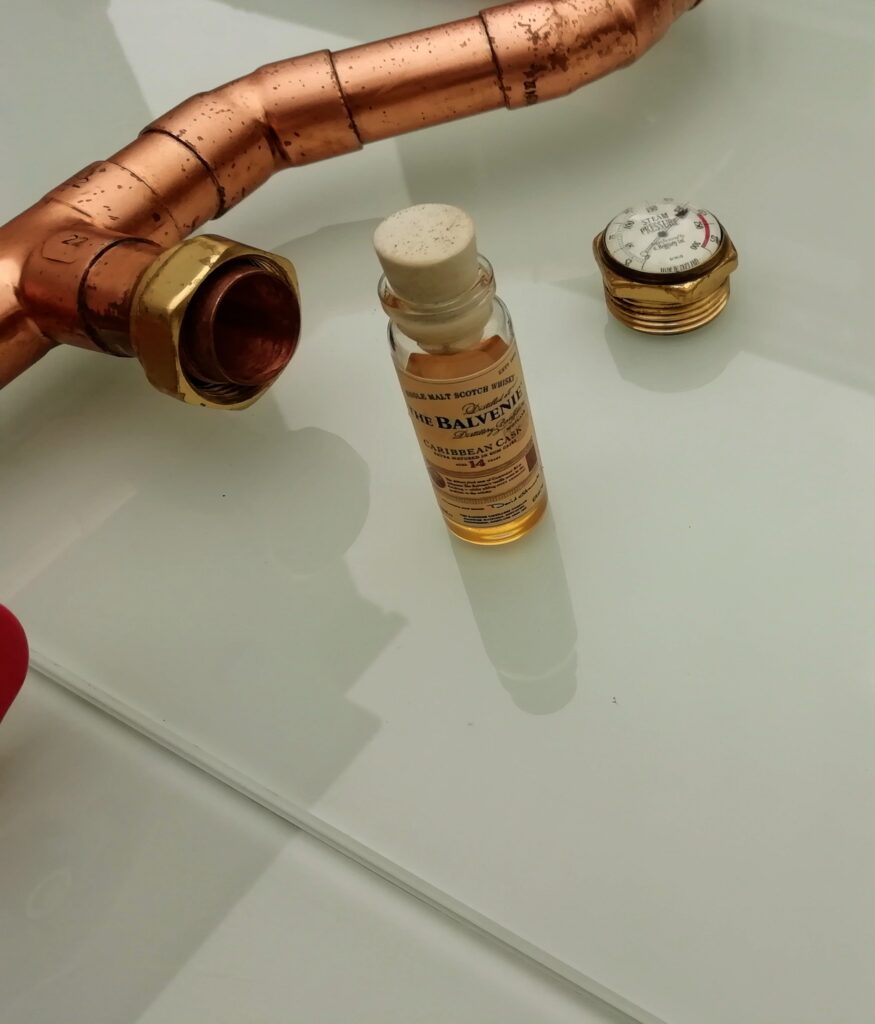
When his health declined, and he needed walking support, Greville took it upon himself to create his own unique walking stick. In his inimitable way, he made this stick out of copper plumbing pipes, even incorporating into his design a small compartment to store a shot of whisky “for emergencies”.
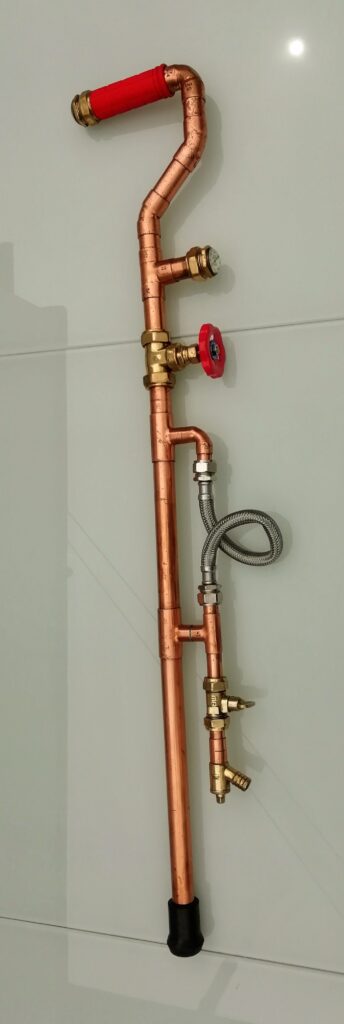
In the final years of his life, as his illness made him increasingly house-bound, Greville’s craftsmanship took a creative turn and he started building works of miniature art – full of humour and a keen observation of human nature. His wife Heather, who curated the exhibition of his work as a fundraising initiative for Sarcoma UK, poignantly and with awe describes how the force of Greville’s creativity and imagination shifted with the decline of his health; that as his world got smaller, so too did his creations.

The exhibition, which took place at the Riverhouse Barn Community Centre in Surrey, showcased over 30 pieces of work that Greville had poured his heart and time into. Each piece of art tells a story, makes you think and puts a smile on your face. Greville had the talent to evoke such feelings in others during his lifetime. To be able to do so posthumously speaks volumes about the extraordinary man that he was.

In admiring these pieces of miniature artwork, I was drawn to the background blurb that Heather had written and displayed at the exhibition’s entrance. In it, she described Greville as a “perfectionist”. There was no undertone of criticism there – it was a factual description, lovingly reflected on with pride, as something to marvel at and celebrate.
This was refreshing to see. It pushed against the notion of perfectionism being frowned upon, as it so often is in the context of work-life balance.

Greville evidently didn’t see perfection as unattainable. He was unapologetically patient, determined to use his precious time to get things just right. His miniature works are exquisitely precise – ingeniously imagined, meticulously illustrated and positioned to perfection. Seeing them together was a quiet masterpiece.
It’s impossible for me to say whether this inclination towards perfectionism enhanced or hindered Greville’s personal sense of balance, nor how his attitude towards perfectionism changed as his health deteriorated, and how it compared to when he was working full-time with a young family. Perhaps it frustrated him as much as it satisfied him; perhaps he battled against it rather than indulging in it; perhaps it tipped his creative pursuits from being considered a “life” hobby to becoming a “work” endeavour.
Sadly, I never thought to ask him. Certainly, from the way Heather describes Greville’s passion for his work, I don’t get the impression that his inclination towards perfectionism was something he ever sought to ‘tone down’.
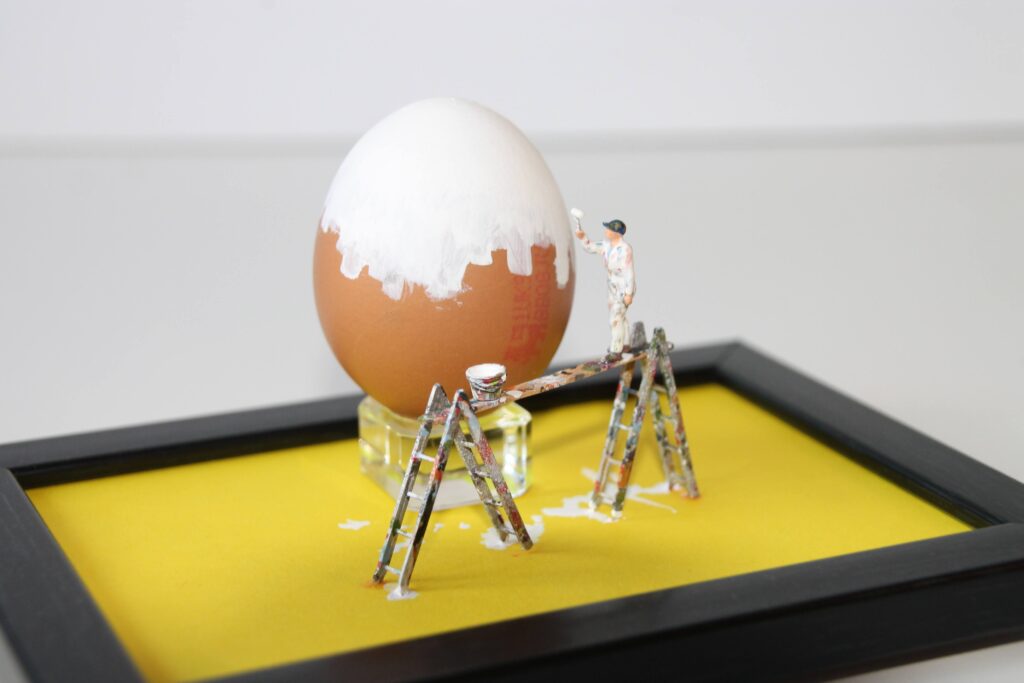
Regardless, the exhibition of Greville’s work was indeed a celebration of perfectionism. It reinforced the validity of the conclusion I reached in the ”Work, Life, Balance Lesson” episode that I mentioned earlier: that the pursuit of balance is deeply personal, and unique to each of us.
If striving for perfection affords you fulfilment, purpose, and satisfaction, then that’s a choice worthy of celebration. There will always be trade-offs, of course – like those I wrote about when reflecting on how perfectionism was depicted in MJ the Musical, of an artist with a tortured sensitive soul, driven to succeed.
But if leaning into your perfectionist inclinations brings you a sense of balance, then how can it be considered a flaw? On the contrary, surely it’s an intrinsic part of who you are. And if it can lead to brilliant creations that touch the lives of others, then it certainly can’t be all bad.
Greville left behind a remarkable legacy – in his family, his friends, and the many lives he touched with his generosity and kindness, both to those he knew, and to countless strangers that he didn’t.
And perhaps one more quiet legacy remains: the lesson that there is no shame in striving for perfection. It’s a beautiful thing to have the patience and persistence to make something exactly as you imagine it. It may not necessarily be essential by everyone’s standards – but it is, in its own way, profoundly worthwhile.
If you’d like to donate to Heather’s fundraising page, you can do so by following this link: