
What running a marathon taught me about Work-Life Balance
What does running a marathon have to do with pursuing a balance between work and everything else in life?
Having spent the past six months or so training for, and then participating in, my first marathon, I can safely say that it isn’t the most obvious path to a balanced lifestyle.
For starters, the commitment it takes is really time-consuming, requiring at least multiple weekday runs, long weekend runs, and strength training in between. And the pain is real, people. So also taking into account the periods you’re out of action recovering, I’d say marathon training occupies more time than your average non-professional sportsperson spends exercising.
Invariably, this involves reprioritising other things in life, which in turn can impact the people around you – those that live with you, for example, or who rely on you.
Nevertheless, thousands upon thousands of people do it every year, all around the world. So clearly there’s something in it.

Before race day, I’d heard many marathon enthusiasts extol the virtues of conquering the distance. I was sceptical about said enthusiasts’ claims that marathon-running is a metaphor for life.
But now, at the risk of becoming a marathon bore, I can see where they’re coming from.
Before I started drafting this blog post, I considered the link between marathon training and the pursuit of a balance between work and everything else in life to be pretty tenuous, but couldn’t resist indulging in a blog post to mark this personal milestone. Writing it up, however, has helped me process all that I learned from the experience, and has made me think that the two have more in common than first meets the eye.
Work, Life, Balance, and Box-Ticking Exercises
Did I mention that I ran an actual marathon? I may have alluded to it once or twice. Yes, I did it! I ran my first marathon. London, 2nd October 2022, that was me. 26.2 miles, running non-stop for over four and a half hours straight. Huge box ticked; long-standing ambition complete.
Running the London Marathon was the most physically challenging and exhilarating thing I’ve ever done, aside from pregnancy and childbirth.
I can see why people find the sport so addictive. The high is hard to match. Running at speed for such a distance felt metaphysical; akin to an out-of-body experience. My mind motored my body in a way that makes no earthly sense.
But beyond the high from the physical side of things, the sense of achievement at completing a target (albeit unnecessary and self-imposed) cannot be underestimated.
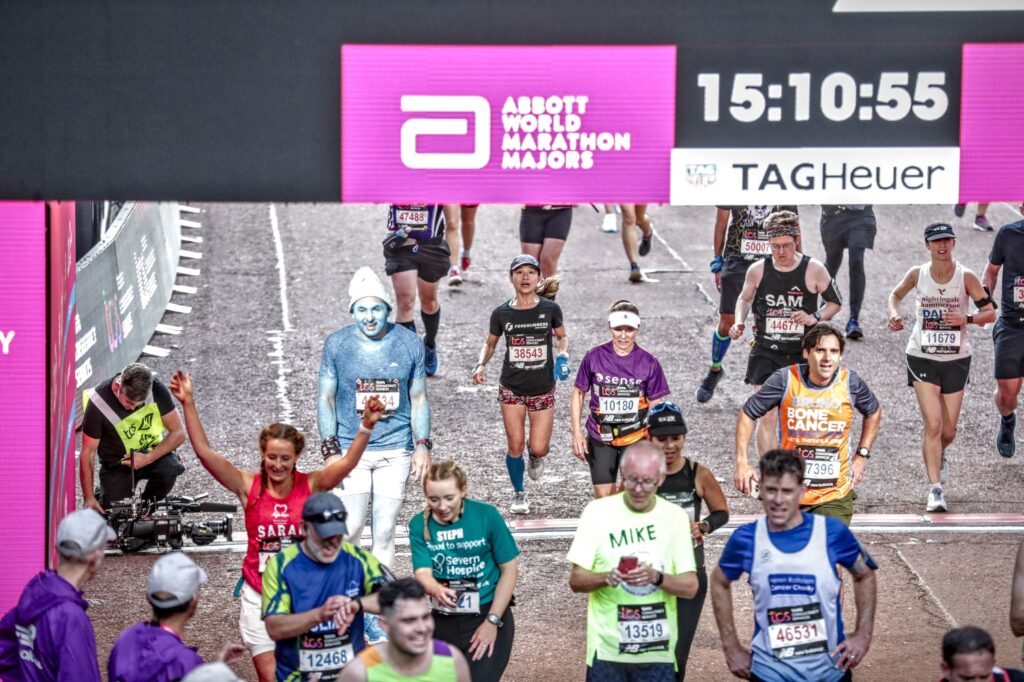
Attaining this long-standing ambition was such a thrill that the adrenaline and euphoria of simply having completed the race felt equivalent to the levels of endorphins coursing through my body from the physical exertion.
Overall, though the commitment it took to tick that box interrupted my balance in the short-term, the sense of achievement more than compensated.
It begs the question “what’s next?”. Because having a goal to work towards is really energising. And so satisfying when you attain it.
Conversely, failing to meet your own targets, or those imposed on you, can have the opposite effect, and can be seriously detrimental to a person’s sense of balance. I’ve observed this in numerous interviews I’ve conducted for my blog, such as Marsha’s story, “From High-Flying Professional to Stay-at-Home Mum”. Marsha described being paralysed by a fear of failing to meet her own elevated expectations.
Setting ambitious targets is all well and good, I’ve learned. As long as they are executed with intention and kindness, and with openness to rein in the plan when it becomes clear that the target is unattainable (see below for more on that). I also learned that having a fan club can really help.
I just called to say, “You can do this“.
The camaraderie of fellow marathon runners, before and during the race, along with the encouragement of loved ones and strangers cheering me on at the side-lines, physically boosted my energy on race day in a way that no Lucozade tablet could.
Again, there was something super-human in this. How could enthusiasm (an emotion, an expression) logically have a direct impact on my physical performance? But it did. The positive energy transferred between runners and the crowds, and it was palpable.

Do people generally encourage one another like this in work, in life? Without an agenda, just genuinely wishing someone to persevere in something they’ve chosen to do? What difference would it make if each person did this more? With colleagues, with friends, with loved ones? Would people feel more balanced about their choices, and would it alter their definitions of success?
I don’t know. But I suppose it wouldn’t hurt to try.
Everyone has a marathon of sorts going on in their lives, at one time or another. A little bit of cheerleading can go a long way.
Core Control
I’ve written before on this blog about the notable impact that acting purposefully and with intention has when it comes to feeling a sense of balance between work and everything else in life.
From Queen Elizabeth II, to the England women’s football team, to multiple people I have interviewed in my ‘Work-Life Balance Profiles’ series, I have observed over and again how mission-drive provides focus, clarity and an inner compass to guide decision-making.
This was true for me both physically and metaphorically when it came to running a marathon.
On training runs, each time I felt my energy levels deplete, or my legs tire, I noticed a full bodily response. My posture would drop, my shoulders would lean forwards, as though pulling my legs along. At other times, even if my body felt strong, I could be slowed down by my motivation waning; I would question why I was choosing to put myself through the pain, spending hours pounding the pavement, missing out on things I could have otherwise been doing.

When this happened, be it mentally or physically, I worked hard to bring my thoughts back to my core. Physically, that meant ‘body scanning’ myself, engaging the muscles in my core to stand up straighter: adjusting my shoulders back and down, and correcting my stride to move my legs more efficiently.
To strengthen my mental resolve when needed, I would equally drive my thoughts back to the core reasons I had taken on this challenge in the first place. Besides my personal ambition, I had committed to fundraise for a charity I care deeply about. I would channel those ‘core’ thoughts – both during my training and on the race day itself – to rationalise my choices in the moment, to justify them and remind myself what I was working towards and why.
If acting purposefully and with intention underpins a healthy work-life balance, it stands to reason that applying a mindset of ‘engaging your core’ to work-life balance choices would be a habit worth perpetuating.

Take it easy on yourself
London Marathon 2022 was actually my third attempt at running a marathon. Both previous times, I had suffered injuries so severe during my training that I had to pull out before race day. Before the opportunity came up for me to run this year, I had as good as resigned myself to set that ambition to bed.
With my past experience front of mind, this time I approached my training gently. Third time around, I was determined to at least make it to the starting line. I paced myself slowly in my training runs, and liberated myself from the ambitious time target I had previously expected of myself. Instead, I focussed on preparing my body for the challenge: I took expert advice on building up my strength, and didn’t scale back on my regular yoga practice to fit in more runs.
I wasn’t able to totally avoid injury, but because of my gentle approach (again both physically and mentally), I made it to the starting line feeling fit and well-rested. On race day, I hit a steady stride to begin with and paced myself to maintain momentum, exceeding the generous time target I could not resist setting for myself.
I hadn’t totally dampened my competitive spirit. But I’d mastered it.
“Self-care” is a buzz word I come across a lot among my blogging and podcasting community. As is “burnout”. Often the people I interview are their own worst enemies when it comes to piling on the pressure (as Darren described in the blog post entitled “Confessions of a Workaholic”).
Each account of “burnout” that has come up in interviews describes the person having to pull out of work that they love in order to recuperate. Which is just as counterproductive as training so hard for a marathon that you have to pull out of the race.
I think of this as another metaphorical marathon lesson that would serve anyone in pursuit of balance.

I can’t ignore the irony of writing a blog post about the lessons that marathon running can offer for maintaining balance when I completely lost mine (literally) around mile 4 and took a tumble, scraping my entire right side across the pavement. I wasted no time getting back on my feet and it wasn’t until after I stopped running that I realised the extent of the damage.
It’s been a few weeks now since the marathon, and the grazes and bruises have almost healed. And whilst the satisfaction of having run a marathon remains, the buzz has started to fade, and the pain become a distant memory.
Nevertheless, the experience overall was utterly unforgettable. And, in writing this blog post, I’ve realised that it adds to the patchwork of perspectives I blog and podcast about on A Fine Balance. Though marathon running isn’t for everyone, the training and committment it requires involves the kind of discipline and intention that is wholly universal, and which can be applied to all things related to work, life and the pursuit of balance.
That, it seems, is also something worth not forgetting.
Good job Dalya!