One of the things I love most about blogging and podcasting is the incredibly vast network it has opened up, creating opportunities to engage with people I wouldn’t imagine crossing paths with otherwise.
One such opportunity was meeting and collaborating with the brilliant author and parenting expert, Anita Cleare, whose work I have admired since discovering her on social media.
It has been such a thrill getting to know Anita and bringing together our ideas on the experience of finding balance as a working parent. Combining her professional experience with my anecdotal research provided some rich material to come up with practical suggestions to support working parents find their balance.
Anita and I went on to co-host an event about work-life balance for working parents, the recording of which you can access on the link below:
The timing of our event coincided with emerging news about the devastation of the terrorist attack that took place in Israel on 7th October. In light of the unfolding horrors, it was challenging to reconcile focussing on something as mundane as everyday parenting and work juggles. It seemed in some ways to be relatively frivilous and unimportant.
However, Anita’s advocacy of parenting positively and mindfully reinforced the significant value – to both children and parents – of exploring the pursuit of balance as a working parent. Insights from my most recent podcast episode, The Pursuit of Balance When You’re Living Through War, further reinforced how the pursuit of balance as a parent is not just a peacetime privilege. Finding balance as a parent is essentially about deciding what really matters. And nothing brings that sharper into focus than the tragedy and injustice of war.
For a working parent to do what needs to be done, as well as what they want to do, when time and attention are at a premium, is not easy. And, of course, there is no ‘one size fits all’ solution. I hope that Anita and my discussion provides some useful tips and clarity on how working parents can work on finding their balance, amidst the multiple and conflicting demands and joys of juggling parenting and career ambitions.

For those interested to read more about Anita and my work collaboration, you can take a look at this article from Anita’s website, where she asks me some questions about finding balance as a working parent: https://anitacleare.co.uk/in-pursuit-of-work-life-balance/.
The full text is included below.
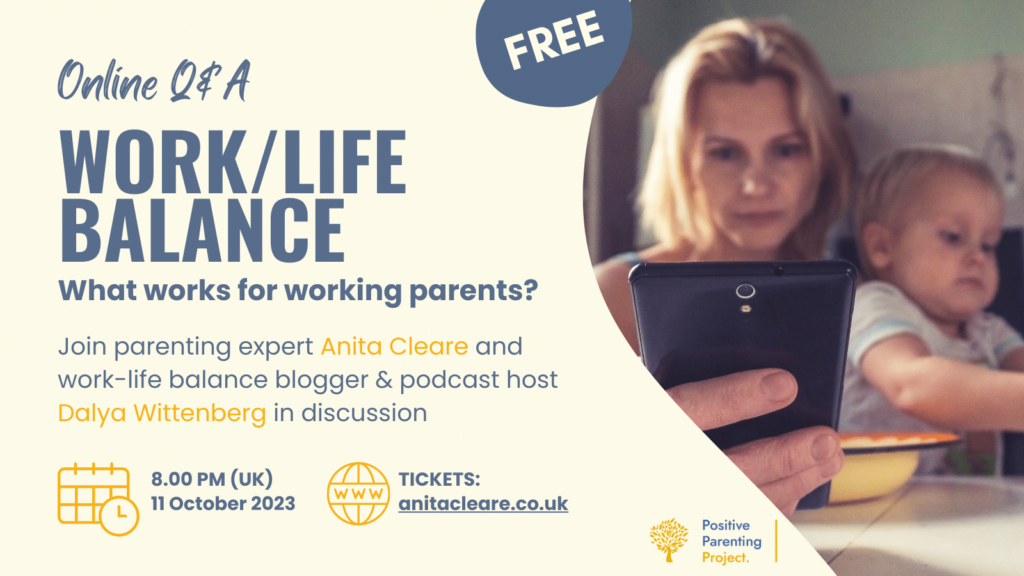
In pursuit of work-life balance
Finding work-life balance can be incredibly challenging as a working parent. There is no one-size-fits-all solution. Balance looks different for different people, and our sense of balance often changes in different stages of our (and our children’s) lives. I interviewed work-life balance blogger and podcast host Dalya Wittenberg (creator of A Fine Balance blog and A Fine Balance – The Podcast) to see if she could help shed some light on the topic.
Tell me a little about the interviews you have been conducting around work-life balance
I created my blog ‘A Fine Balance’ in the thick of the pandemic in 2020, when my work-life balance had been thrown off kilter. Many people around me at the time were similarly grappling with their sense of balance, juggling work, and home lives in lockdown. I started reflecting on what I valued about my work and home life – and why – and I started talking about it with others too. I was intrigued by how everyone I spoke to placed different values on the various components of their lives, even those whose situations bore similarities.
Eventually I started putting my thoughts down in writing and took a leap out of my comfort zone by setting a up website: www.a-fine-balance.com.
The concept was to host conversations reflecting on the diverse and multi-faceted complexity of work-life balance choices, with the purpose of learning from one another – with curiosity, not judgement – and celebrating our differences. After a while, readers kept suggesting that the blog would work well in a podcast format, so I decided to give it a try. The podcast launched on the first anniversary of the blog. And the stories keep coming.
Each interview opens with the same question: “What figure quantifies your work:life ratio, and why?”. From thereon, my guest is invited to share their approach to balancing their time at work with other things that they want – or need – to do. Through telling their ‘work-life balance story’, we explore their rationale for prioritising some things over others.
The interview provides an opportunity for introspection, deepening guests’ understanding of their choices, and encouraging them to reflect on, and share, their wisdom and insights for their own and others’ benefit.
How would you sum up the key lessons from those interviews?
Generally speaking, I’ve found that the actions a person can take to improve their sense of balance are, quite frankly, common sense more than wildly ground-breaking. That’s not to say they are easy to implement, or that finding your balance is a straightforward pursuit.
Often, the power lies in the individual choosing to commit to an action – be it as seismic as changing careers, or as incremental as taking a walk during a lunch break. Understanding yourself and what will personally bring you an improved sense of balance is key. There is certainly no “one size fits all”. And, of course, a person’s sense of balance fluidly shifts throughout the course of their life and career. Being intentional and open to regularly reviewing and adjusting where you focus your time and attention seems to be a helpful approach.
There is a common misnomer that reducing the “work” side of your work:life ratio is the optimal way to improve work-life balance. But I’ve absolutely found that not to be the case. Of course, reducing working hours can sometimes help people regain or maintain a balance with other things in life, but it’s not always the solution – for multiple reasons.
One interviewee, for example, Jhilmil Kishore, a single mother who works full-time as an architect, resolutely quantified her work:life ratio as 75:25, declaring how caught up her identity is in her career. Similarly, another interviewee, Gilles Dahan, a married father of three with an extensive career in banking, unapologetically quantified his work:life ratio as 80:20, stating: “my work is my health”.
The overriding lesson I keep coming back to is that finding your balance matters. In the short-term, feeling discontented with the way you balance work with other things in life can be manageable. But I’ve observed that over the long-term, it can result in feelings of guilt, frustration, or exhaustion, which can impact negatively on both a person’s mental and physical wellbeing. In the extreme, it can lead to ‘burnout’, and having to stop doing the things you want or need to do. From the conversations I’ve had, I’ve learned how unsustainable and damaging this can be.
Much as “burning out” can be detrimental to your own wellbeing, it can impact negatively on those around you too. And the inverse seems to apply: when you feel a contented sense of balance, you’re better placed to serve those around you. In the words of one of my first interviewees, Soli Lazarus: “you can’t pour from an empty cup”. For working parents this is a particularly valuable lesson.
What ideas have you collected that might help parents find their own balance?
Many people that share their stories with me have found their “sweet spot” and reached an optimum sense of balance that they passionately want to promote; others who are less content with their sense of balance, have told me that that they want to share their story in the hope that talking it through will afford them some clarity.
This was the case, for example, when I interviewed Kerry, a “solo mum” who had pursued IVF through sperm donation, and found her balance skewed by a never-ending “to-do list”: “Where is the fun? Where is the play?”, she reflected.
Interviewing people on a such a personal and sensitive subject is not something I take lightly, and often a conversation will uncover deep-rooted reasons and assumptions that underpin how people choose their priorities.
Whatever family set up you have, juggling parenting and work responsibilities in tandem is an immense challenge. Reflecting on whether you’ve got the balance right for you at any given moment is the first step in the pursuit of balance. From there, you’re better placed to intentionally decide whether you want to accept the way things are, or make changes.
You can learn a lot by listening to others’ experiences. I find the interviews I’ve done with parents whose children are grown up, such as retired management consultant Tom McLaughlan, provide a particularly helpful perspective. And hearing from working mums who are still ‘in the thick of it’, such as drama teacher and founder of a performing arts school, Sarah Macmull (mum of three), and project manager Laura Krantz (mum of five), can spark ideas and give working parents the feeling of not being alone.
Understanding the prioritisation choices of those who either don’t have children (such as Laurie Macpherson who talked to me about how she celebrates her “childfree” status), or stay-at-home-mums who have chosen to opt out of a career after having children (like Michelle and Nadine), can also provide a useful perspective for self-reflection.
What impact do you think a parent’s approach to work-life balance might have on their children?
Invariably, it seems that parents act as a baseline for how their children stack up their own priorities. However, I haven’t come across any uniformity in how this plays out.
In some cases, it manifests itself in a person emulating behaviour and choices they admire in their parents, as seen in Matthew’s story. In others, a person may choose to go in a different direction to the example that was set to them during their upbringing, like interviewees Susan and John did; and sometimes a person’s determination is ignited under the influence of a parent, empowered not just to emulate certain values, but to go a step further and forge new paths in the spirit of their parents’ ambitions, as one interviewee, Sheara, described doing in her story.
However it plays out, a parent’s power to influence the approach their children take to balancing work with other things in life cannot be ignored or underestimated. It seems to exist whether we choose for it to, or not. In the absence of any hard or fast rules about how to instil in your child a work-life balance that works for them, I would defer to the key lessons I alluded to earlier: pursuing a balance that individually works for you as a parent helps you to accept or change your priorities, supporting you to serve the people and things that matter most to you. Work and parenting demands and opportunities continually change, so remaining attuned and open to the fluidity of your sense of balance also has an impact.
Again, I find seeking inspiration from parents who are further along their journey infinitely valuable, such as my podcast guest Ruth Todd, who is the Chief Commercial Officer of HS2 and a mum of two grown-up sons. Ruth has chosen to pursue a career involving demanding, high-pressured and full-time jobs, which she balances around a busy home life. When I interviewed her, she acknowledged that her choices often didn’t align with many of her peers who had tapered their career ambitions after having children. She said: “I don’t expect people to make the same choices I’ve made. They’re my choices. I own them. And I live with the consequences of them, and the joy of them”.
What are your next steps?
I’ve almost come to the end of producing Season 2 of ‘A Fine Balance – The Podcast’ and I have plenty of ideas to work up for Season 3.
Meanwhile, I’m developing my newly redesigned website to make it a more accessible resource to support people in their pursuit of balance. The stories I’ve written up and recorded are now organised according to occupations, and themes e.g. “the pursuit of balance when you’re single… when you’re a teacher… when you’re a parent” etc. The potential feels infinite as everyone has a ‘work-life balance’ story to tell. And as the conduit through which many of these stories pass, there is always something for me to reflect on and write about.